Pickup
Merchant
- Kitchen marks the accepted order ready
- Merchant controls the buyer handoff
- Merchant records the supported completion outcome
Pickup procedures remain subject to the merchant's approved operating policy.
Product
SaaSMX uses separate operational surfaces for buyer entry, merchant review, kitchen work, pickup or delivery handoff, and completion. Each surface has a defined responsibility and boundary.
This page explains product structure. It does not display a live merchant environment, invent an interface, or promise compatibility with every outside system.
Operational surfaces
The sequence names who uses each surface, what it makes visible, and what remains outside its responsibility.
The buyer enters through an ordering experience led by the merchant's identity and approved configuration.
Boundary: The ordering surface begins the order path. It is not presented as the merchant's complete operation or POS.
The merchant reviews the connected order, sees the current condition, and decides whether operational work can continue.
Boundary: Order Control governs the SaaSMX workflow. It does not replace every function of a POS or outside merchant system.
Accepted work moves into a kitchen-focused surface without exposing merchant administration or business settings.
Boundary: Kitchen responsibility begins after merchant acceptance. The kitchen surface does not authorize merchant decisions.
A ready pickup order remains connected to the merchant-controlled handoff and completion path.
Boundary: The merchant remains responsible for the supported pickup process and any identity or handoff checks it requires.
A supported delivery order can move from merchant readiness into the approved provider handoff.
Boundary: The delivery provider controls its own service availability, pricing, courier operation, and provider-specific outcomes.
The final supported outcome closes active work and preserves the order's completed operational state in the SaaSMX workflow.
Boundary: This operational record is not represented as an accounting ledger, tax record, or replacement for the merchant's POS records.
Buyer surface
The ordering surface begins the connected path with the supported menu, fulfillment, buyer, checkout, and payment details. It does not represent the full merchant operation.
Merchant-branded ordering
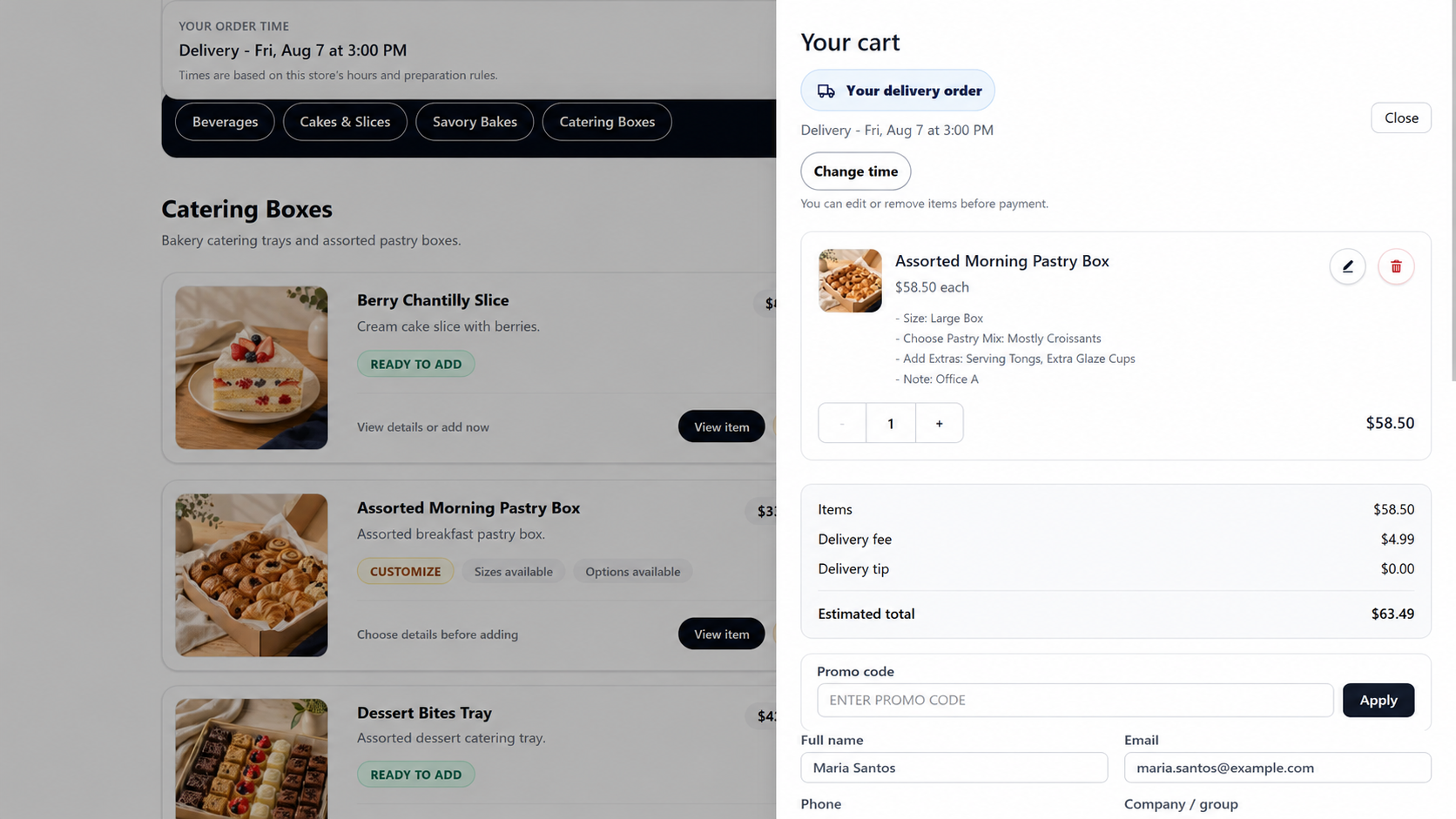
Merchant-branded ordering shows menu selection, item configuration, scheduled delivery context, buyer details, and the order total before checkout.
Demo screenshot — presentation-cleaned identity data. Nonproduction demonstration data only; no live merchant, customer, staff, payment, or order information is represented.
Merchant surface
The merchant reviews the supported order path, resolves visible conditions, and decides when operational work may advance. Merchant decisions remain separate from kitchen work.
Order Control
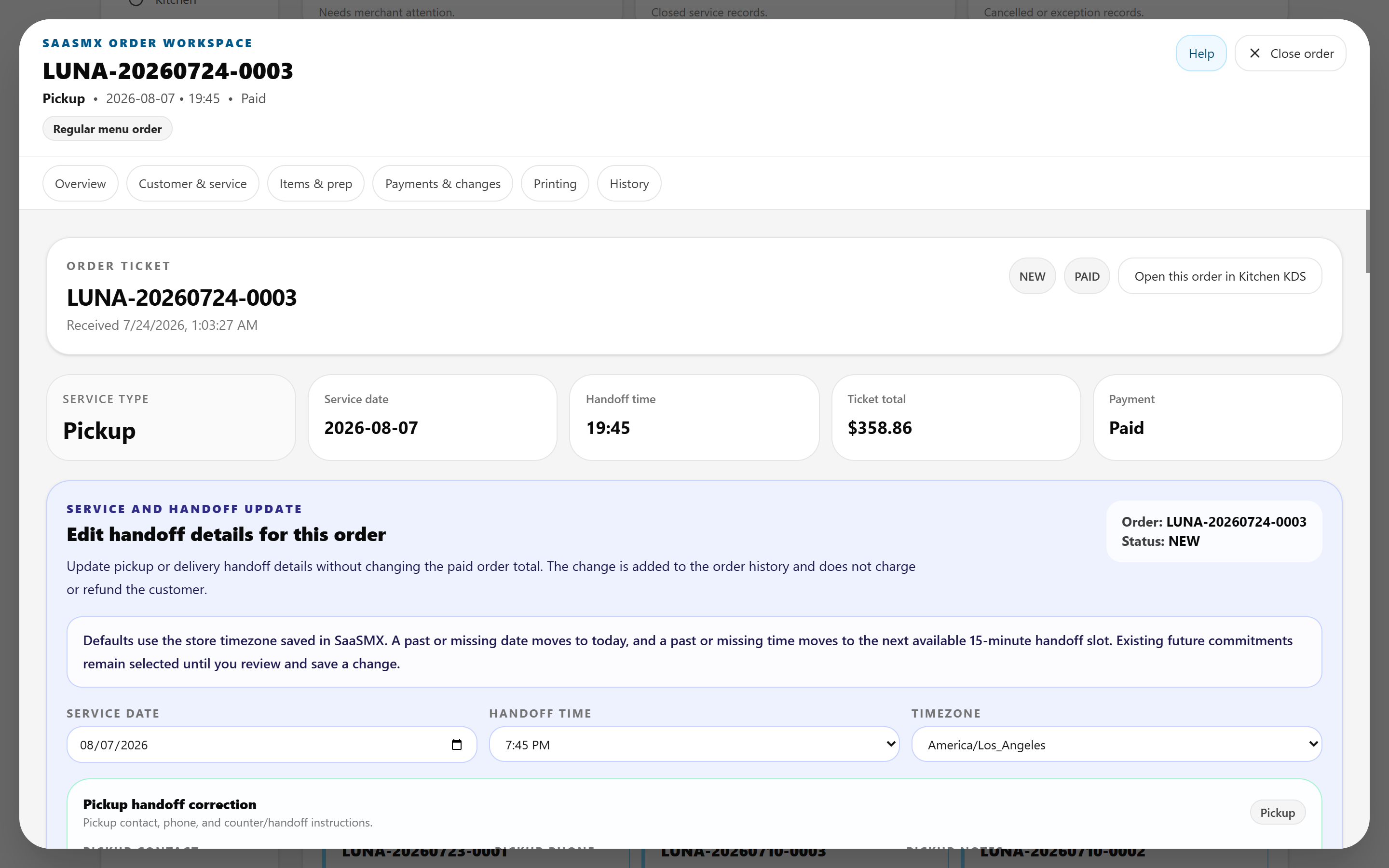
The order workspace keeps order identity, payment and service state, dates, handoff information, KDS transition, and operational history together.
Demo screenshot — presentation-cleaned identity data. Nonproduction demonstration data only; no live merchant, customer, staff, payment, or order information is represented.
Kitchen surface
Kitchen responsibility begins after merchant review. The kitchen-focused surface keeps preparation and readiness visible without exposing account, billing, or business settings.
Kitchen preparation
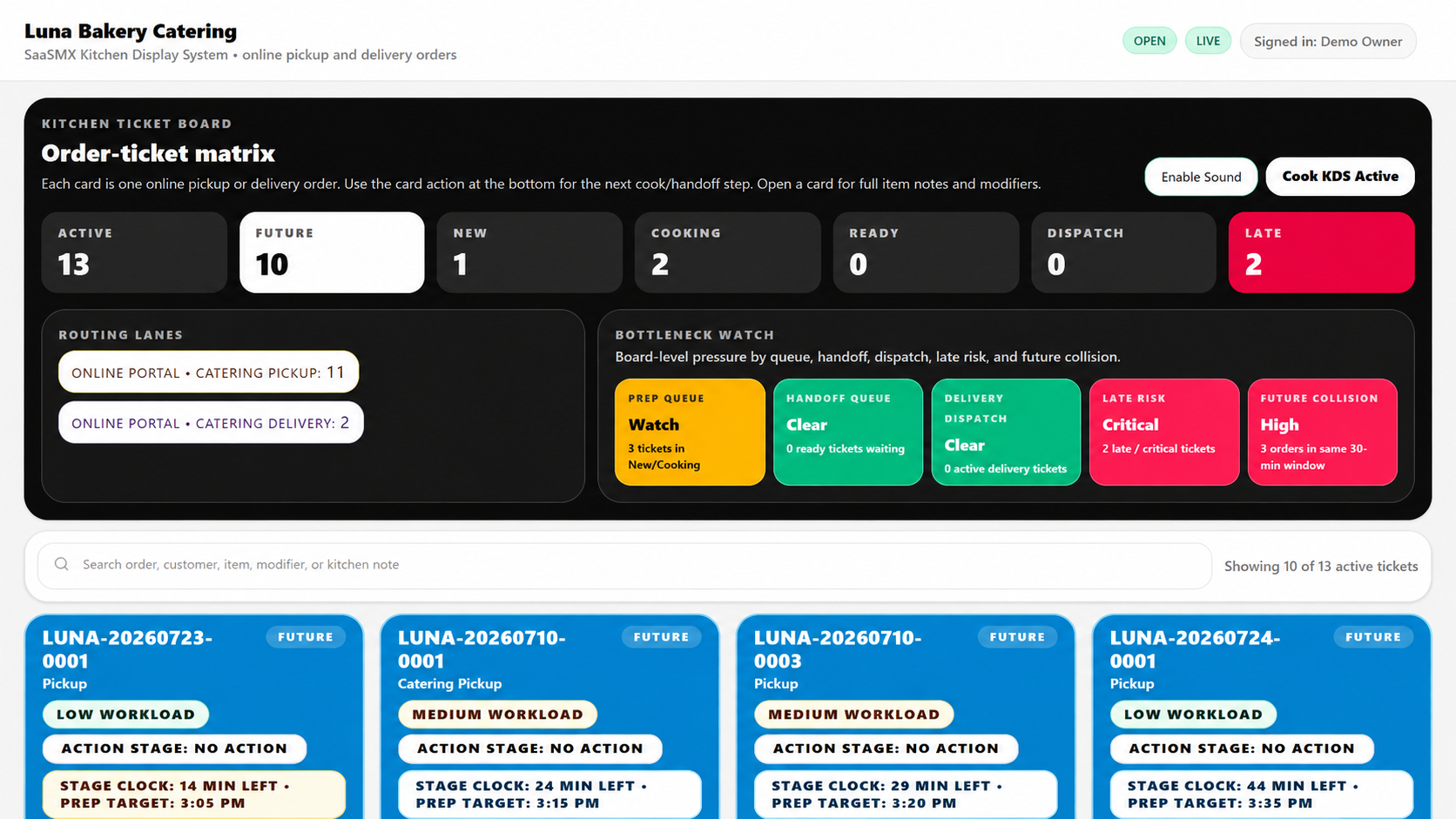
Kitchen KDS shows accepted work, preparation state, handoff lanes, timing context, and stage progression without exposing merchant administration.
Demo screenshot — presentation-cleaned identity data. Nonproduction demonstration data only; no live merchant, customer, staff, payment, or order information is represented.
Fulfillment handoffs
Both begin with accepted, prepared work. Responsibility changes at the final handoff, and delivery-provider controls remain outside the SaaSMX product boundary.
Pickup
Pickup procedures remain subject to the merchant's approved operating policy.
Delivery
Provider availability, pricing, courier conduct, and provider rules remain outside SaaSMX control.
Attention states
A visible condition, responsible role, and next action keep review work separate from normal preparation and completion.
Completion
The supported pickup or delivery outcome becomes the final workflow state. SaaSMX does not present that state as an accounting ledger, tax record, or POS replacement.
Retained in the workflow
The order no longer remains in an active preparation or handoff queue.
Not represented
Accounting, tax, provider, and POS records remain governed by their own systems.
System boundary
SaaSMX controls the supported order workflow while connected providers and merchant systems retain their own responsibilities.
Inside the boundary
Connected or separate